
The Trails
Guide
Maps
Miles/Ele
Permits
Resupply
Forum
Current Weather Conditions
Weather Notes
Northern High Sierras
Central High Sierras
Southern High Sierras
Gear
Gear List
Gettin Started
Layering
Discussion
Testing yourself and your gear
Gear Reviews
Echo Summit to Carson Pass
Hiking
Miles and Elevations
through the
Meiss Country Roadless Area
Backpacking Miles and Elevations
The Tahoe to Yosemite, Pacific Crest and Tahoe Rim Trails
Languages
Translate
Trail Arts
The art of walking
Physical Preperation
Trail Skills
The trail
Off the trail
Scrambling
Maps
Navigation
Camp skills
Food
Resupply
Food
Other
Photo Catagories
Trail Stories
Trail Culture
News and Science
Links
Groups
Books
ALL |
MILES TYT-PCT |
MILES PCT |
MILES TYT |
MILES TRT |
REGIONAL TYT-PCT |
TRAIL TYT-PCT |
MAPS |
ALL |
ALL |
Miles & Elevations
|
|||||||||||||||||||||||||||||||||||||||||||||||||||||||||||||||||||||||||||||||||||||||||||||||||||||||||||||||||||||||||||||||||||||||||||||||||||||||||||||
Backpacking Miles
|
|||||||||||||||||||||||||||||||||||||||||||||||||||||||||||||||||||||||||||||||||||||||||||||||||||||||||||||||||||||||||||||||||||||||||||||||||||||||||||||
| Location | Elevation | Mileage | ||
| Echo Summit | 7377 | 0 | ||
| +143 | .91 | |||
| Frog Pond trail junction | 7520 | .91 | ||
| +140 | .50 | |||
| Footbridge | 7640 | 1.41 | ||
| +520 | .74 | |||
| Overlook | 8160 | 2.15 | ||
| +600 | .74 | |||
| Peak 8905 high point | 8760 | 2.89 | ||
| Total elevation Gain Echo Summit to Peak 8905 +1383 feet over 2.81 miles |
||||
Peak 8905
to
Meiss Cabin
Elevation drop
360 feet over 6.28 miles
Echo Summit to Carson Pass
Backpacking Map
| Location | Elevation | Mileage | ||
| Peak 8905 high point | 8760 | 2.89 | ||
| -240 | .6 | |||
| Bryan Meadow Junction | 8520 | 3.49 | ||
| +120 | .85 | |||
| Sayles Canyon, second junction | 8640 | 4.34 | ||
| +320 | 1.27 | |||
| Schneider's Camp junction | 8960 | 5.61 | ||
| -160 | 1.19 | |||
| 1st Showers Lake junction | 8800 | 6.80 | ||
| -120 | .41 | |||
| 2nd Showers Lake junction | 8680 | 7.21 | ||
| -280 | 1.88 | |||
| Round Lake trail/Meiss Cabin | 8400 | 9.09 | ||
| Total elevation Gain Peak 8905 to Meiss Cabin +360 feet over 6.28 miles |
||||
Meiss Cabin
to the
Carson Gap
Elevation Rise
400 feet over 1.52 miles
| Location | Elevation | Mileage | ||
| Round Lake Jnct/Meiss Cabin | 8400 | 9.09 | ||
| +400 | 1.52 | |||
| Carson Gap Pond | 8800 | 10.61 | ||
| Total elevation Gain Meeks Bay to Phipps Pass +2561 feet over 8.88 miles |
||||
The Tahoe to Yosemite
and
Pacific Crest Trails
Part Company
at the
Carson Gap
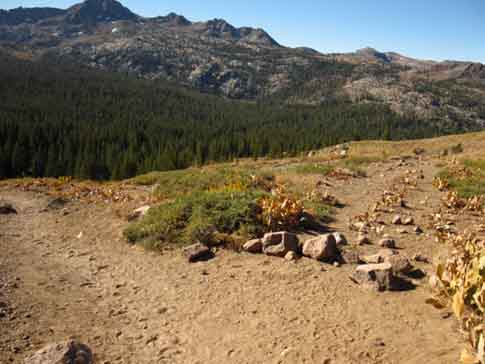
PCT/TY trail junction just South of the Carson Gap
looking South towards Round Top
Carson Pass Region Map
Just South of the Carson Gap is the 1st Southbound Junction between the Pacific Crest Trail and Tahoe to Yosemite Trail.
Southbound backpackers the Pacific Crest Trail continue to our left, or Southeast, along the main trail bed to the Carson Pass. The Tahoe to Yosemite Trail turns right to head straight down the mountain to Highway 88.
At the bottom of the steep drop on the South side of Carson Gap is another unmarked trail down to Highway 88.
From Highway 88 the Tahoe to Yosemite backpacker approaches Woods Lake, where we find two routes to choose from to reach Round Top Lake.
The Carson Pass Region Map above lays out all of our backpacking options.
Location elevation milesCarson Gap Pond 8800 10.61
Continuing South from the Carson Gap...
Two Routes South
from
The Carson Gap
400 feet over .6 miles |
200 feet over 1.39 miles to the Carson Pass on the PCT |
Down to Hwy 88
elevation miles
To Hwy 88 8400 .6
Echo Summit
to
Hwy 88
11.2 miles
The Tahoe to Yosemite trail breaks off to the Southwest at the Carson Gap down to Hwy 88 on the way to Round Top Lake.
To Carson Pass
elevation miles
Carson Pass 8600 1.39
Echo Summit
to
Carson Pass
12 miles
The Pacific Crest Trail continues down the main trail to Carson Pass from the Carson Gap.
Additional
Miles and Elevations
Information
North and South
PCT-TYT-TRTMiles and Elevations
North & Northeast
North |
Northeast Alternative Trailhead and Route TRT Meyers to Meiss Cabin miles and elevations |
PCT & TYT
Miles and Elevations
South & Southwest
| Southeast Pacific Crest Trail Carson Pass to Ebbetts Pass miles and elevations |
Southwest Tahoe to Yosemite Trail Carson Gap to Lake Alpine miles and elevations |
Video Playlist |
Note |
The miles and elevations pages for this trail guide, like the High Sierras, divides itself into ups and downs. Our miles are generally done either going up to the top of the mountain, or we are coming down from the mountaintop into the valley that separates us from the next mountain. This means that the mileages and elevations between the peaks and the valleys are going to be important in determining how many miles we can reasonably expect to cover each day. This figure will be instrumental in planning where we are going to camp every night, and ultimately this information will determine how many days it will take us to cover a given distance. This in turn establishes our proper food load. I have organized the miles and elevations data to reflect the overall climbs and descents this section of trail naturally divides itself into. Between Echo Summit and the Carson Gap in the Meiss Country Roadless Area along the Tahoe to Yosemite and Pacific Crest Trail there are 10.5 miles and 705 feet of of elevation overall elevation change. But this elevation figure does not adequately describe the terrain. Furthermore, the climbs we encounter generally contain down sections within the climbs. The descents will have ups within their downs. Though I hike to give you an "on the trail" look at conditions, many of these slight trail contradictions are below the level of reporting. But they are present in most terrains. The overall character of the terrain between Echo Summit to Showers Lake can best be categorized as a roller coaster. We are basically climbing and descending constantly until we reach Showers Lake. From Showers Lake a gentle decline across meadowed terrain mixed with forest brings us down to climb into the Northern edge of the Meiss Meadow. Remember these important rules #2> We know we are good to go when we invite the endless procession of ridges up to the top. |
TOP OF PAGE
Backpacker Forums Post it on Above we come to the Front Page of the High Backpacking Trails and Topics Forums. Below we break the forums down into categories:
Anyone can post text comments in the existing forums, but only members can post up new topics, along with images, maps, and formatting. If you have experiences, comments, questions, trip reports, trail conditions updates or pictures and videos of the Tahoe to Yosemite/Pacific Crest Trail from Echo Summit to Carson Pass, post up here as an unknown hiker or as a member: Section: |
PCT Miles North: Meeks Bay to Echo Summit PCT Miles South: Carson Pass to Ebbetts Pass
Contact
Alex Wierbinski